Slow Hands, Sound Work: Bringing New People into a Trade That Rewards Patience
In 2026, the recruitment advert is expected to do a great deal of work. It must promise progression, flexibility and immediate purpose, often in fewer words than a delivery note. There is nothing wrong with clarity, but a family firm that has traded since 1946 learns to treat the advert as the beginning of a relationship rather than the end of a recruitment problem. Bringing a new person into the trade is not a transaction. It is a transfer of judgement, and judgement is rarely acquired in a fortnight.
That is not a romantic argument for slowness. It is a practical one. The work we do for customers carries consequences: a measurement taken too quickly, a message misunderstood, a job sequenced badly. Most of these errors are small enough to correct and serious enough to matter. The purpose of a patient apprenticeship is to make sure the first mistakes are cheap, observed and turned into lessons before they reach a customer’s premises.
The first month is for watching
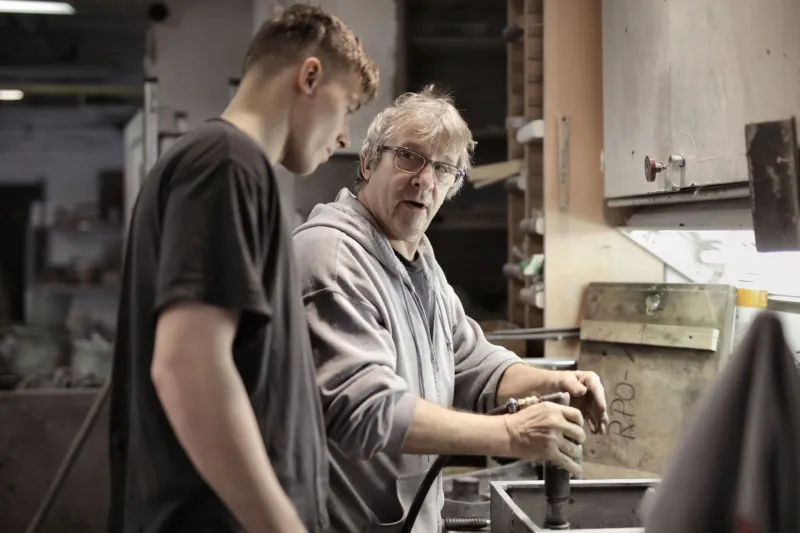
A new starter’s first weeks are often described as shadowing, which can sound passive. It should not be. Watching an experienced hand is an active discipline: noticing how a job is set out, how materials are checked, how a customer is greeted, how a problem is raised before it becomes a complaint. The newcomer is not there to fetch and carry alone. They are there to learn the rhythm of the work and the standard expected of it.
In our experience, this period works best when one named person is responsible for the newcomer. A rota of vague supervision produces vague understanding. A single mentor, with time set aside for explanation and questions, gives the learner a fixed point of reference and gives the firm a clear view of progress. The mentor should be chosen for patience as well as skill. The fastest worker is not always the best teacher.
Supervised work is still real work
There is a temptation to separate training from the job: a few weeks of instruction, then a handover. That approach flatters the training plan but often fails the person. Adults learn a trade by doing it, provided the doing is properly bounded. A new recruit might prepare the work area, check the order against the job sheet, accompany a senior colleague on a customer visit, or complete a familiar task under direct review.
Each of these is a real contribution, not a pretend exercise. The difference is that the responsibility is staged. The newcomer knows what they are accountable for and what remains with the mentor. The customer receives the same standard of work, and the firm keeps its promise while the next pair of hands is being formed.
The mistakes that become lasting lessons
Every trade has its own version of the same early errors: the item ordered in the wrong size, the appointment noted for the wrong day, the finish rushed because the next job was pressing. A firm that shouts about such things teaches people to hide them. A firm that reviews them calmly teaches people to think ahead.
We favour a short debrief while the job is still fresh. What was supposed to happen? What happened instead? Where was the warning sign? What will be done differently next time? The lesson should be written into the job record, not left to memory. Over time, these notes become a quiet curriculum for the next newcomer. They also show customers, when an explanation is needed, that the firm is capable of correcting itself.
The commercial pressure to hurry
The argument for speed is not foolish. Labour is tight, customers want dates, and every extra pair of supervised hands can feel like a cost rather than an investment. Short attention spans are not only a customer problem; they are a business problem too. It is easy to convince oneself that a capable person will pick up the rest as they go.
Sometimes they will. Often they will not, or not without a bill attached. Rework, callbacks, damaged materials and lost confidence all carry a price. So does the strain on experienced staff who are left to cover for someone who was pushed too far too soon. The commercial case for patient apprenticeship is not that speed is unimportant. It is that speed purchased without judgement is rarely speed at all.
What good looks like in practice
A sensible programme need not be elaborate. It needs a named mentor, a clear sequence of duties, regular review and a record of what has been signed off. It should include customer contact early enough for the newcomer to understand who the work is for, but not so early that the customer becomes an unpaid examiner. It should make room for questions, including the ones that sound obvious. Most of all, it should be honest about what the person cannot yet do.
That honesty protects everyone. The newcomer is not set up to fail. The mentor is not asked to vouch for skills that have not been tested. The customer is not invited to discover a gap at their own expense.
A promise that outlasts the person
A family firm’s reputation is built by individuals, but it cannot depend on any one of them. The point of teaching the trade slowly is to pass on not only technique but temperament: how to speak to a worried customer, when to stop and check, why a tidy finish matters even when no one will see it. Those things are caught more often than taught, and they are caught by working alongside someone who cares.
Customers may occasionally notice that a job is being done with an extra pair of hands and a little more discussion. In our view, that is no bad thing. It signals that the firm is thinking beyond the next invoice. The work will still be finished, the promise will still be kept, and the person who learns it properly will one day be the one doing the teaching.